

The transceiver with the lowest latency per bit.
Light in fibre is fast. The transceivers at each end are slow. We build the transceiver that adds the least delay, so every bit arrives sooner.
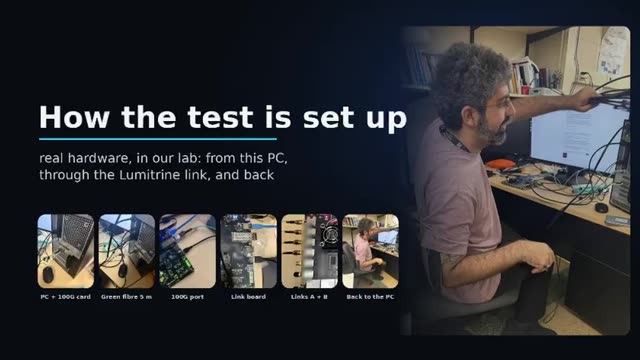
Short haul · the lowest latency 0.65 µs One way per link, measured live in metro fibre, 0.5 to 80 km. A carrier 10G wave adds up to 1 µs, a 100G wave 3 to 4 µs.2 Watch the test ↓Watch the three live tests

Products
All specifications Catalog 2026 (PDF)2.5×
Up to 2.5 times less delay than today's coherent modules, for links between cities. Measured live, on off-the-shelf hardware.
0.65 µs
One way per link in metro fibre, 0.5 to 80 km, with no error correction. Up to 1.5× faster than a carrier 10G wave, and 4.6 to 6.2× faster than a 100G wave.2
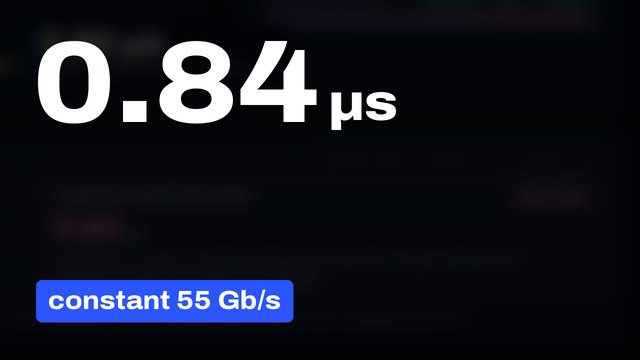
0.84 µs
One way per link at 30 km, with the data rate held at a constant 55 Gb/s and error correction on. 0.83 to 0.85 µs at every range from 0.5 to 40 km. Measured live.
Why a microsecond is worth money.
Light in fibre covers about 200 metres every microsecond. Every microsecond a transceiver saves is like moving the two ends of the link 200 metres closer, without laying any new fibre.
AI across data centres
When training spans sites, GPUs sit idle while data crosses the link. Less delay means less waiting.
Trading
Firms already pay for shorter fibre routes. We take microseconds off the route they already have.
5G and 6G networks
Radio networks have tight timing budgets. Faster links leave more room for everything else.
Any coherent link
Data-centre interconnect, metro and long-haul links run on the same coherent modules we outperform.
Natural Intelligence, fast enough to live inside the link.
Our patented Natural Intelligence watches each link and tunes it by itself. It decides in under 100 nanoseconds, so it adds almost nothing to the delay it removes.
US 2025/0373332 A1| Coherent and long haul | 3.2 µs per link, measured live |
|---|---|
| Short haul, latency based | 0.65 µs per link, measured |
| Short haul, fixed data rate | 55.3 Gb/s at 0.83–0.85 µs, measured |
| Natural Intelligence decision | under 100 ns |



Sources for the published figures
- Cisco, 400G Digital Coherent Optics QSFP-DD Optical Modules Data Sheet: round-trip latency at 400GE of 4.7 µs (400G ZR+, QDD-400G-ZRP-S) and 7.9 µs (400G ZR, QDD-400G-ZR-S). cisco.com
- Zayo, New Jersey Triangle route overview, round-trip latencies: NYSE to NY4 is 374 µs on dark fibre, 376 µs on a 10G wave and 382 µs on a 100G wave; on the other routes a 10G wave adds 0 to 1 µs and a 100G wave 6 µs. The delay a carrier wave adds per link, one way, is half the difference: up to 1 µs (10G) and 3 to 4 µs (100G). zayo.com (PDF)
- Smartoptics, TQD013-TUNC-SO 400G ZR/ZR+ QSFP-DD data sheet: latency 5 µs (400G oFEC) to 11 µs (100G oFEC). smartoptics.com (PDF)
- ADVA Optical Networking (now Adtran), "Low latency for DCI and mobile applications: why and how?", 2019: 100G OTN with soft-decision FEC 15.24 µs, and 11.44 µs with fewer decoder iterations. adtran.com (PDF)
- Cisco, NCS 2000 400 Gbps XPonder Line Card Data Sheet: latency end to end 28 µs (100GE, SD-FEC 15%). cisco.com
AI Atlas figures are measured on our bench, 9 to 11 November 2026: hardware timestamps on 256-byte probes, one way per link, the fibre left out. Every delay on this page is what the terminals add; the fibre itself adds 4.9 µs per km for everyone.
Test the lowest latency per bit on your network.
We are choosing a few early pilot partners. A mutual NDA comes first.